
Are Psychics Deliberately Scamming You, or Do They Truly Believe They’re Gifted? A Former practitioner Reveals the Truth
Are Psychics Scamming You? A Former Practitioner Breaks Down the 3 Types
Is your psychic truly “gifted” or just performing? This deep dive into a viral Reddit thread exposes the 3 types of psychics in the industry. Learn how to spot exploitative scammers and find trustworthy, refund-backed platforms.
You’re sitting in front of your screen, cursor hovering over the “Book Now” button, and two voices are fighting inside your head. One desperately wants to hear that reassuring answer. The other is asking the uncomfortable question — “Am I about to get scammed?”
You’re not alone. A now-legendary Reddit thread on r/AskReddit asked psychics point-blank: Do you knowingly scam your clients, or do you actually believe you’re gifted?
One former psychic’s brutally honest answer ripped the curtain wide open: “I know for a fact that I am not psychic, but I wouldn’t say that I scammed people.”
That single sentence captures the strange, uncomfortable gray zone this entire industry lives in. The line between “performative service” and “malicious fraud” is thinner than you think — and blurrier than you’d like.
Before you hand over your hard-earned money to a stranger on the other side of a screen, you need to understand the three types of people you might be dealing with.
Breaking Down the Psychic Industry: Do They Actually Believe They Have Powers?
The answer is more complicated than a simple yes or no.
In that viral Reddit thread, a former psychic practitioner (username: psychicthroaway) wrote an extraordinarily detailed breakdown of the industry. Their response earned massive upvotes because it was raw, unflinching, and precise — like a scalpel cutting through the fog of a deliberately murky business.
They divided every psychic into three categories. Here’s what each one looks like from the inside.
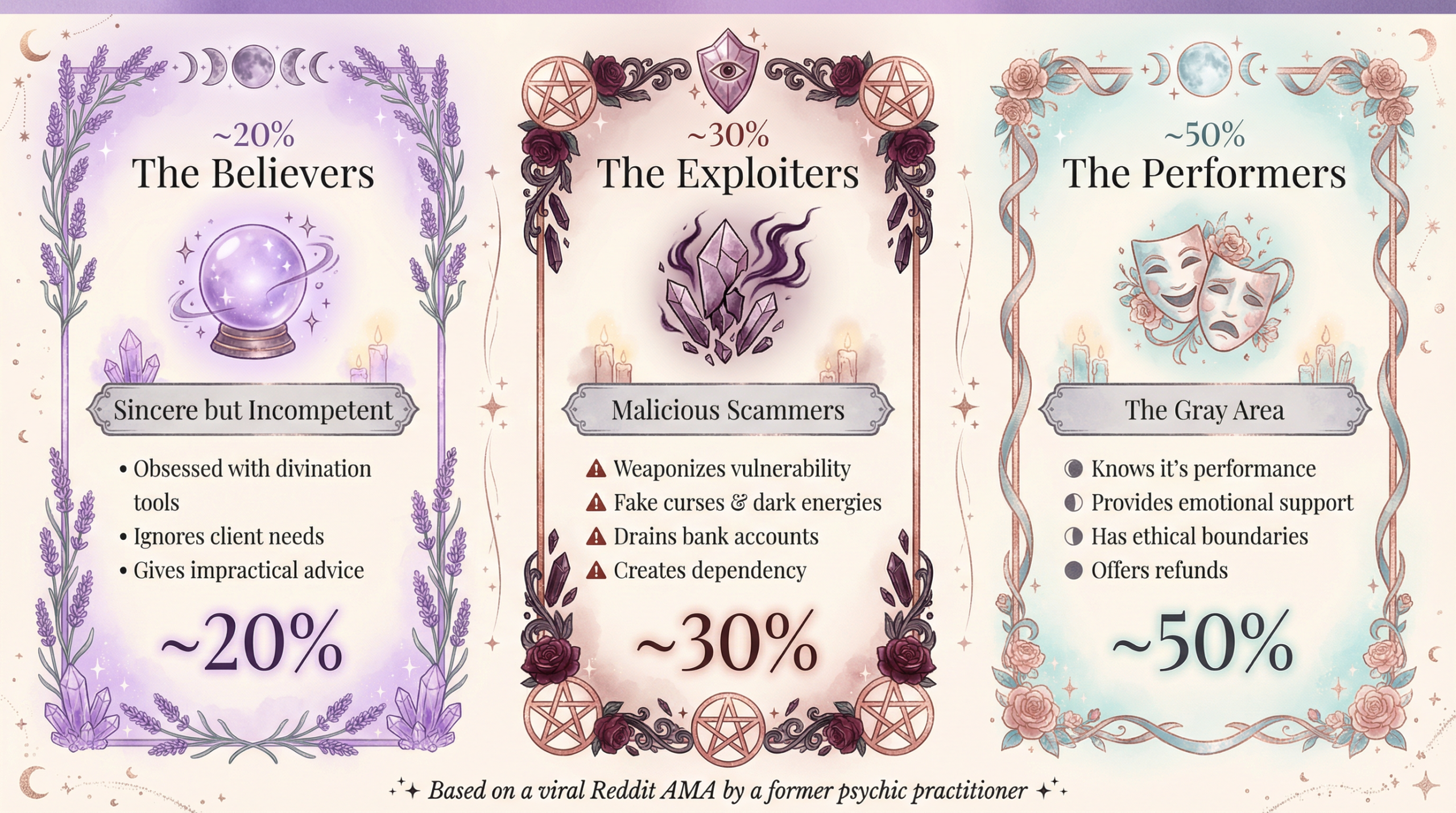
Type 1: “The Believers” — The Worst Psychics Are Often the Most Sincere
You’d think the ones who genuinely believe in their own powers would be the most authentic, right?
Dead wrong. According to this former practitioner, Believers are by far the worst psychics in the business.
They get so obsessed with their divination tools — tarot cards, crystals, rune stones — that they completely stop listening to what the client actually needs.
Here’s a real example from the thread: A female client nervously asked how to approach a coworker she had a crush on. The Believer psychic spent 30 straight minutes telling her an elaborate story about their past lives during the Civil War — she was a nurse, he was a wounded soldier, and their souls were eternally bonded through the carnage of battle.
His practical advice? “Burn some sage to ward off evil energies.”
She wanted dating tips. She got Civil War fan fiction.
These psychics make up roughly 20% of the industry. They’re not evil — but their sincerity actually makes them more dangerous for your wallet, because you walk away with absolutely nothing useful.
Type 2: “The Exploiters” — The Real Scammers
If Believers are just incompetent, Exploiters are predators.
These people have mastered the art of weaponizing your vulnerability. They’ll pretend to receive messages from your deceased grandmother, tug at your heartstrings until you’re emotionally hooked, then systematically drain your bank account.
Their playbook includes:
- Claiming you’re “cursed” and only they can lift it
- Fabricating terrifying “dark energies” and selling expensive “cleansing rituals”
- Exploiting cultural superstitions to manufacture fear
- Deliberately creating psychological dependency so you keep coming back
The most chilling part? They don’t care if they destroy you.
The Reddit poster was blunt: if a client is spending themselves into bankruptcy, an Exploiter won’t hesitate — they’ll keep extracting money right up until there’s nothing left.
This group makes up about 30% of the industry. And here’s the gut punch: many of the most famous, celebrity-status psychics fall squarely into this category.
Type 3: “The Performers” (The Everybody Else) — The Biggest Gray Area
The remaining ~50% is where it gets genuinely interesting. This is the category that former psychic belonged to: they know they’re not actually psychic, but they don’t consider themselves scammers either.
Sounds contradictory? Think about it for a second.
Most of these people are ordinary folks — stay-at-home moms, freelancers struggling to make rent, people who stumbled into one of the few work-from-home gigs that doesn’t require a degree. They tend to be naturally emotionally intelligent, skilled at reading people, or they’ve unconsciously picked up cold reading techniques.
Here’s how that former practitioner described their own work:
“The kinds of things I would say in my readings were eerily similar to conversations with my friends or family when they seek advice, only instead of ‘I think’ I would say things like ‘I sense’ or ‘I am feeling that’ — which are also true statements.”
They drew a compelling analogy: magazine models are airbrushed, the burger in the McDonald’s ad is made of wax — society runs on polished illusions. Their psychic service was a performance, no different from a clown at a birthday party or a bartender who pretends to care about your day.
But they drew a hard line for themselves:
- Website clearly stated “for entertainment purposes”
- 100% refund offered to any unsatisfied client, no questions asked
- Never touched “communicating with the dead” — too sensitive, too exploitative
- Never used fear, curses, or threats to manipulate anyone
- Proactively refunded clients who were clearly in financial trouble
One story stood out: a client facing bankruptcy kept buying readings, asking when things would get better. Every single time, the practitioner refunded her money and told her: “You don’t need a psychic. You need a financial counselor.”
Why Do “Fake” Psychics Still Feel So Accurate?
If most psychics know they’re not actually clairvoyant, why does it still feel like they’re reading your mind?
Two words: cold reading and the Barnum effect.
Cold Reading: “Mind Reading” Without Any Supernatural Powers
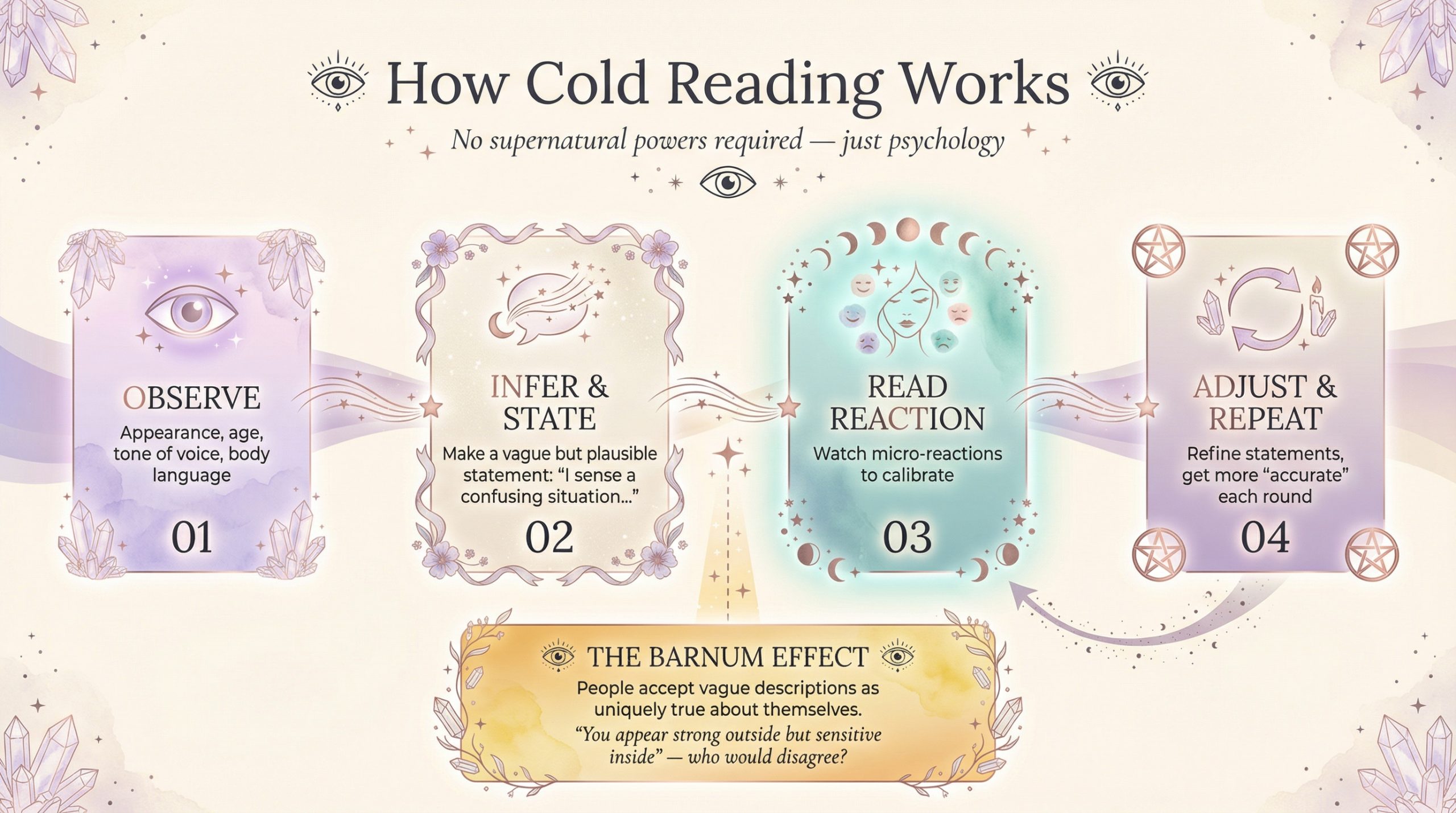
Cold reading is a set of psychological techniques. The core principle is simple — observe someone’s appearance, tone of voice, age, and body language, rapidly infer information about them, then package those inferences as “intuitions” or “visions.”
Example: A woman in her 30s comes in asking about relationship problems. A skilled cold reader opens with something vague: “I sense you’ve been going through a confusing emotional situation recently.”
Let’s be honest — a 30-something woman paying for a psychic reading about love is almost certainly going through something confusing. That’s not a prediction. That’s a probability.
Then they watch your reaction. Eyes light up? Slight nod? Furrowed brow? They adjust in real time, getting more “accurate” with every response you give them.
As that Reddit poster put it: “Cold reading is insanely easy if you are typically good with people.”
The Barnum Effect: Why Horoscopes Always Feel “So True”
There’s an even deeper psychological mechanism at play — the Barnum effect.
People tend to accept vague, general personality descriptions as uniquely applicable to themselves. When a psychic tells you “you’re someone who appears strong on the outside but is deeply sensitive inside” — honestly, who on earth would disagree with that?
Cold reading + Barnum effect. Stack these two together, and you have the complete operating system behind psychic services. No supernatural powers required. Just sharp observation + empathy + strategically vague language.
This raises a question worth sitting with: if a psychic genuinely helps you process emotions and reduce anxiety, does the “performance” itself have value?
That’s for you to decide. But at minimum, you should understand why it feels accurate — it’s not a gift. It’s psychology.
Warning: 3 Signs You’re Dealing With an “Exploiter”
Regardless of whether psychics are therapists-in-disguise or skilled performers, one type demands zero tolerance: the Exploiters.
If you encounter any of these three red flags, leave immediately.
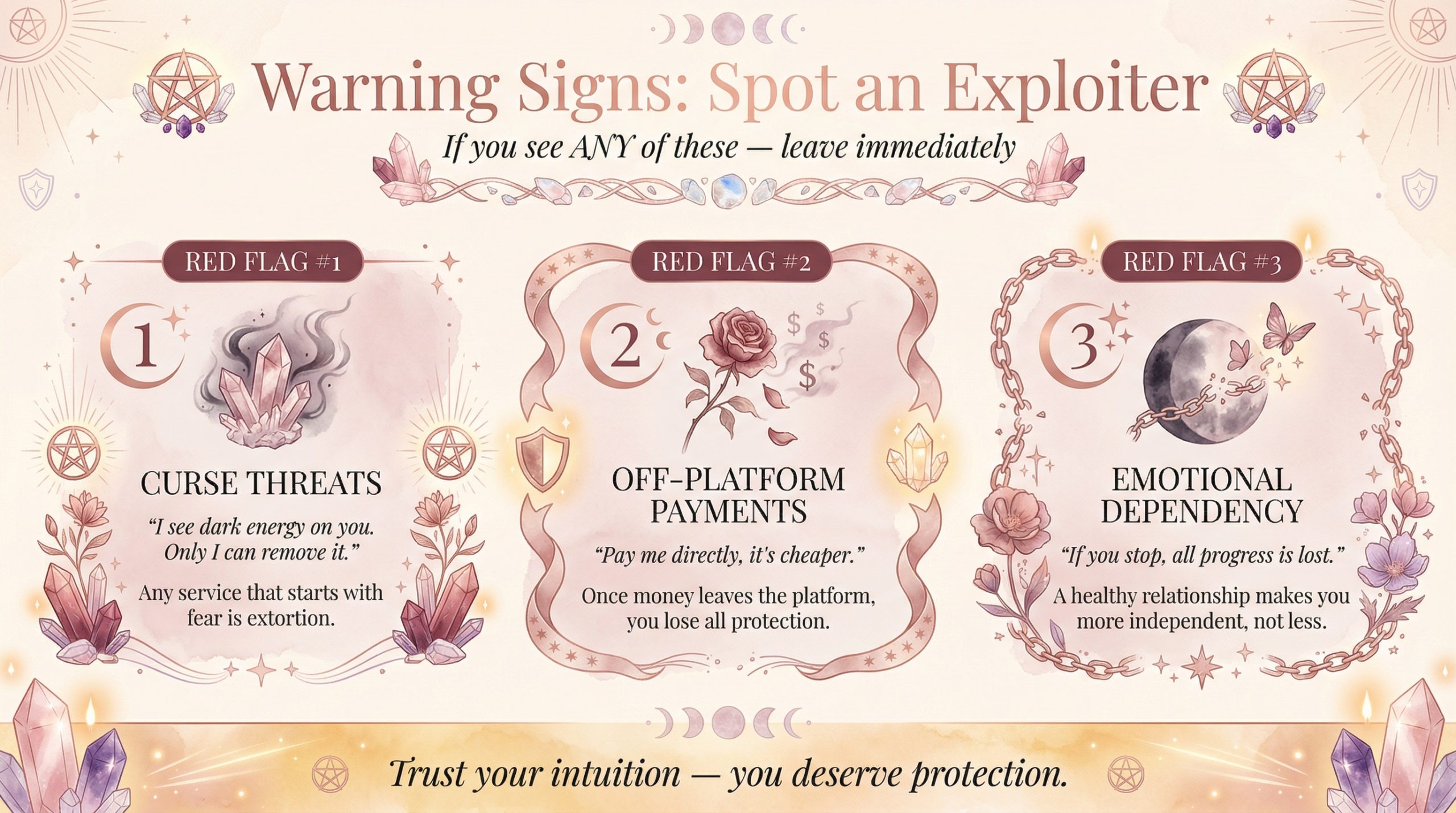
Red Flag #1: Curse Threats
“I see a very dark energy/curse attached to you. If you don’t address it soon, your health, finances, and relationships will all suffer.”
This is the Exploiter’s classic opener. Manufacture fear first, then sell the “solution” — usually an outrageously priced “cleansing ceremony” or “spiritual ritual.”
The rule is simple: any “service” that begins with a threat isn’t a service. It’s extortion.
Red Flag #2: Pushing Off-Platform Payments
Legitimate psychics on reputable platforms process all transactions through the platform, with full records. If a psychic starts suggesting you “pay directly via PayPal,” “send a Venmo,” or “it’s cheaper if we do this privately” — they’re almost certainly trying to dodge the platform’s complaint and refund system.
The moment your money leaves the platform’s protection, you lose all recourse.
Red Flag #3: Emotional Manipulation & Creating Dependency
“Your situation is unique — we need ongoing sessions to monitor it.”
“I saw something important, but we ran out of time. We’ll need to continue next session.”
“If you stop now, all the progress we’ve made will be lost.”
These lines serve one purpose: keep you coming back, keep you paying.
A healthy advisory relationship should make you more independent over time, not less. If you find yourself needing to check in with a psychic weekly — or daily — just to feel okay, you’ve fallen into a dependency trap.
How to Choose a Psychic Platform: 4 Non-Negotiable Standards
Enough about what to avoid. How do you actually choose wisely?
Whether you’re a first-timer or a returning client, these four criteria are your baseline:
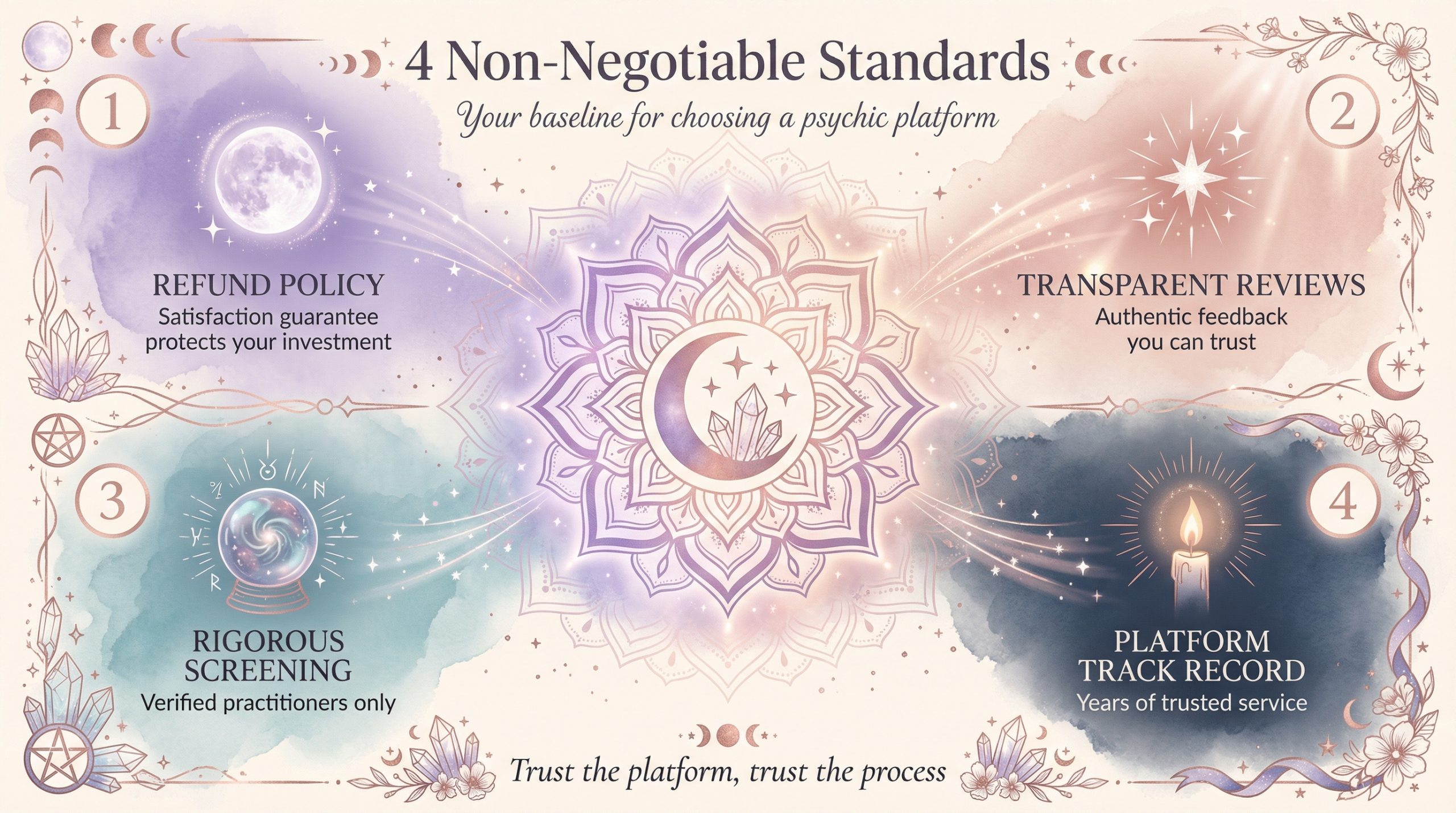
Standard #1: A Clear Refund Policy
This is the most important one. No refund policy = don’t even consider it.
Trustworthy platforms offer a “satisfaction guarantee.” If the reading was clearly low-effort — the psychic was dismissive, evasive, or obviously making things up — you can contact support for a refund.
This mechanism doesn’t just protect your wallet. It’s also how platforms weed out bad psychics. High refund rates lead to demotions or removal.
Standard #2: Transparent Transaction History & Reviews
You check reviews before buying a $20 product on Amazon. Why would you skip that step for a psychic reading?
Reputable platforms display each psychic’s:
- Total number of completed readings
- Authentic user reviews (including negative ones that the psychic cannot delete)
- Average rating
Be suspicious of psychics with nothing but 5-star reviews. Nobody satisfies everyone. A spotless record either means the reviews are fake or the platform is deleting criticism.
Standard #3: Rigorous Screening for Psychic Practitioners
Not just anyone should be able to hang a “psychic” shingle — at least not on a legitimate platform.
Quality platforms require practitioners to pass:
- Identity verification
- Skill assessments (simulated reading evaluations)
- Background checks
This screening process exists specifically to keep Exploiters out.
Standard #4: Platform Reputation & Track Record
A platform that’s been operating for 5+ years with a solid customer service infrastructure and industry reputation vs. a psychic who DMed you from a brand-new Instagram account — which one is more likely to vanish with your money?
Longevity = accumulated trust. A platform that has survived and grown over years has a model that’s been tested by the market.
How to Find a Truly Reliable Platform in a Crowded Market
Now that you know the four standards, here’s how to apply them in practice:
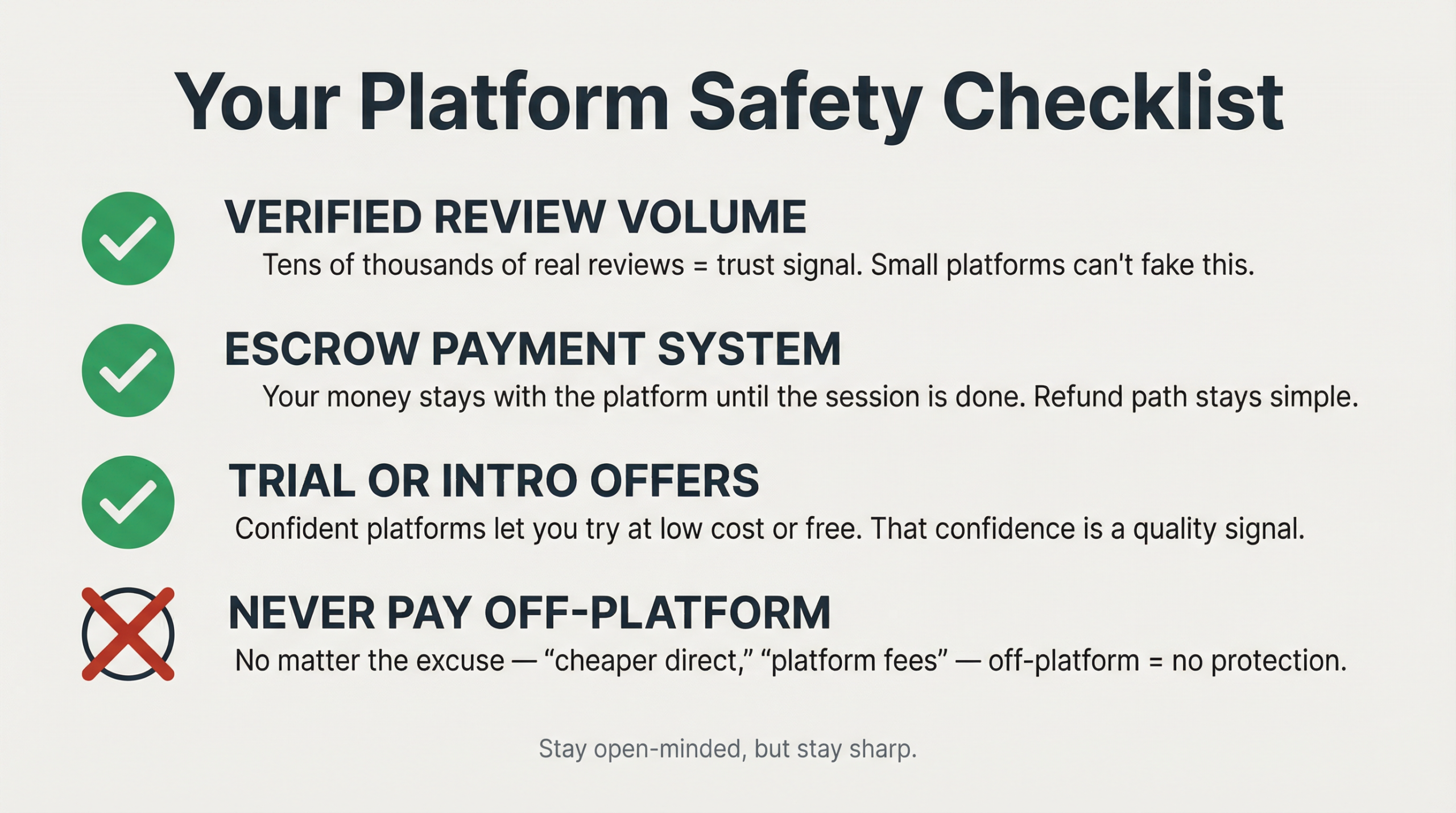
First, prioritize large platforms with tens of thousands of verified reviews. Review volume itself is a trust signal — small operations simply can’t generate that level of authentic feedback.
Second, confirm the platform uses an escrow-style payment system. Your money goes to the platform first. The psychic only gets paid after your session is complete. Not satisfied? Your money is still with the platform, and a refund is straightforward.
Third, look for introductory offers or trial sessions. Platforms confident in their psychic quality are willing to let you test the waters at low cost — or even for free. That confidence is a quality signal in itself.
Fourth, avoid any psychic who pushes for off-platform transactions. No matter the excuse — “the platform takes too big a cut,” “it’s cheaper if we go direct” — the moment you leave the platform, you leave your protection behind.
Final Thoughts
The psychic industry isn’t as dark as “they’re all scammers,” and it’s not as magical as “they really have supernatural powers.”
The most valuable insight from that Reddit thread? Most psychics are, at their core, emotional support service providers. The best ones genuinely help people process their thoughts, ease anxiety, and offer the kind of outside perspective that friends and family often can’t.
But only if you find the right person on the right platform.
Stay open-minded, but stay sharp. Set a budget ceiling. Know the red flags. Choose platforms with refund guarantees and real review systems.
Seeking emotional comfort is a real, valid human need. There’s no shame in it. But handing your money to a scammer — that’s worth being ashamed of.
Frequently Asked Questions
Q1: If psychics are just “therapy” or “performance,” am I wasting my money?
It depends on what you’re looking for. Going to the movies or a concert is also paying for an emotional experience. Many emotionally intelligent psychics offer perspectives and emotional support that friends simply can’t. The question is whether the price matches the value.
As long as no one is leveraging fear (curses, threats) to extort you, and you genuinely feel better afterward, it’s not a scam. But if you’re expecting precise predictions of the future, keep your expectations in check.
Q2: How can I quickly identify a malicious, scam-type psychic?
Watch for three red flags:
- Curse threats: Claiming you or your family is cursed and only expensive rituals can fix it.
- Avoiding platform oversight: Pushing for private payments to dodge complaints and refund systems.
- Emotional manipulation: Deliberately creating dependency, pressuring you to keep buying sessions for “the next step.”
Professional platforms have zero tolerance for these behaviors.
Q3: Why is using a major platform safer than finding a private psychic on social media?
Three words: institutional trust. Major platforms typically offer:
- Vetting processes: Multiple rounds of identity and skill verification before a psychic is listed.
- Review transparency: Transaction records and negative reviews that psychics cannot delete.
- Payment protection: Your money stays with the platform until the session is complete — the psychic doesn’t get paid until you do.
Q4: Can I get a refund if I’m unhappy with a reading?
This is the baseline of a trustworthy platform. Private psychics almost never give refunds once they have your money. But professional platforms typically have “satisfaction guarantee” policies. If the session felt rushed, dismissive, or clearly fabricated, you can contact support for a refund. This also serves as the platform’s quality control — psychics with high refund rates get demoted or removed.
Q5: What should I know before trying a psychic reading for the first time?
Two principles: open mind, clear head.
- Set a budget: Never go into debt for a psychic reading.
- Watch for cold reading: Pay attention to whether they’re fishing for information from you.
- Choose high-rated psychics: Prioritize practitioners with 10,000+ completed readings and plenty of detailed, authentic reviews.
💬 Was this article helpful?
Give Us Your Opinion
Be the first to rate!
About the Author: Sarah Mitchell